Kirk McAuley

- Professor and Chair
Biography
Kirk McAuley received his PhD in British and American literature from the State University of New York, University at Buffalo, in 2006. Since then, he has taught in the Expository Writing Program at the University of Oklahoma, and the Division of Humanities at New College (the honors college) of Florida. He joined the English Department at WSU in August 2008.
McAuley is the recipient of a Fulbright Scholarship at the National Library of Scotland in Edinburgh, UK (2015 – 2016), and he was a Research Fellow at the Robert H. Smith International Center for Jefferson Studies in Charlottesville, VA (May 2011). McAuley received an ASECS-Keough Naughton Institute for Irish Studies Summer Fellowship at the University of Notre Dame in 2018, and he served as the Lawrence Ruff Visiting Chair in Eighteenth-Century Studies (Fall 2019) at the University of Dayton.
Research / Teaching Interests
Eighteenth-Century Studies, Transoceanic Studies, British and American Literature and Culture to 1900, Literature and Ecology (including Plant, Animal, and Anthropocene Studies, Ecofeminism and the Eco-Gothic), Colonialism and Empire Studies, Slavery and Abolition, Print Culture, and Gender Studies.
McAuley’s book – The Ecology of British and American Empire Writing, 1704–1894 (Edinburgh University Press, 2024) (*See disclaimer) – invites us to consider the ways in which particular unruly natures, including animals, plants and minerals, actively intervene in literature to decentre the human. Drawing upon invasion biology, McAuley offers transformative ecocritical interpretations of eighteenth- and nineteenth-century British and American literature and highlights the heterarchical nature of empire building. This includes analyses of texts composed by (or about) persons residing at, or just outside, the edges of the British and American Empires, including St Kitts and Nevis, Haiti, Cuba, Hawaii and Samoa, which were built around the global transfer of animals and plants. Offering biotic readings of this literature, McAuley highlights the human place in nature and provides practical literary examples of the ways oceans facilitate the confusion of time and place.
McAuley’s first book, Print Technology in Scotland and America, 1740–1800 (Lewisburg, PA: Bucknell University Press, 2013) (*See disclaimer), investigates the mediation of popular-political culture in Scotland and America, from the transatlantic religious revivals known as the Great Awakening to the U.S. presidential election of 1800. In it, he reveals how seemingly disparate events, including journalism and literary forgery, were important deployments of print not as a liberation technology, but as a mediator of political tensions.
He has begun working on a new book project exploring the ecology of Imperial Gothic Fiction.
Publications
Books
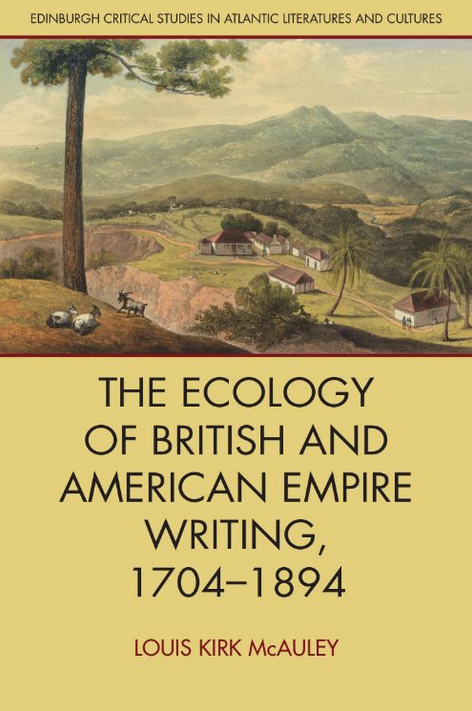
The Ecology of British and American Empire Writing, 1704–1894 (Edinburgh University Press, 2024)

Print Technology in Scotland and America, 1740–1800 (Bucknell University Press, 2013)
Selected Articles and Book Chapters
- “Walking and Weeding in a Shrinking World: The Strange Case of Robert Louis Stevenson,” ISLE: Interdisciplinary Studies in Literature and Environment, (*See disclaimer) Volume 26, Issue 3, Summer 2019, Pages 570–593.
- “‘Calcutta Still Haunts My Imagination’: The Confusion of Old and New World Ecologies in Early Caribbean Literature,” The Edinburgh Companion to Atlantic Literary Studies, edited by Clare Elliot and Leslie Eckel (Edinburgh University Press, 2016)
- “Romantic Recycling: The Global Economy and Secondhand Language in Equiano’s Interesting Narrative and the Letters of the Sierra Leone Settlers,” with Debbie Lee (Co-Author), Global Romanticism: Origins, Orientations, and Engagements, 1760 – 1820, edited by Evan Gottlieb (Bucknell University Press, 2014)
- “‘What’s Love Got To Do With It?’: Sympathy, Antipathy, and the Unsettling of Colonial American History in Film,” A Companion to Historical Film, edited by Constantin Parvulescu and Robert A. Rosenstone (Oxford: Wiley-Blackwell Publishing, 2013), 513 – 539.
*Disclaimer: This link leads to an external website that is not hosted by the university. The views and content expressed are those of the faculty member and do not represent the official positions of the university.