Nishant Shahani

- Professor
Biography
Nishant Shahani received his MA in English Literature and Critical Theory at the University of Mumbai, India and a PhD in English at the University of Florida with a specialization in gender and sexuality studies. At WSU, he teaches undergraduate and graduate classes in queer and feminist theory, LGBT studies, health humanities, and postcolonial theory and literature.
Research/Teaching Interests
Queer Theory and Politics (specifically queer of color critique and transnational sexualities); Trans studies; Feminist Theory; Health Humanities; Disability studies; AIDS histories and historiographies; Postcolonial Theory and Empire; South Asian Studies (specifically India); Utopian Studies; Film and media studies.
Shahani’s most recent book monograph, Pink Revolutions: Globalization, Hindutva and Queer Triangles in Contemporary India (Northwestern University Press, 2021) (*See disclaimer) describes how queer politics in India occupies an uneasy position between the forces of neoliberal globalization, on the one hand, and the nationalist Hindu fundamentalism that has emerged since the 1990s, on the other. While neoliberal forces use queerness to highlight India’s democratic credentials and stature within a globalized world, nationalist voices claim that queer movements in the country pose a threat to Indian national identity. The book argues that this tension implicates queer politics within messy entanglements and knotted ideological triangulations, geometries of power in which local understandings of “authentic” nationalism brush up against global agendas of multinational capital.
Shahani’s first monograph, Queer Retrosexualities: The Politics of Reparative Return (Lehigh University Press, 2012) (*See disclaimer) examines the retrospective logic that informs contemporary queer thinking; specifically the narrative return to the 1950s in post-1990s queer and LGBT culture in the United States. The book inquires into what motivates the return to a historical moment informed by the bruises and wounds of history; but more importantly, it poses the question of how such a turn backwards could be theorized as reparative or even hopeful. This book shows how the framework of queer retrospection offers new ways of understanding history and culture, of reformulating disciplines and institutions, and of rethinking traditional modes of political activism and knowledge production.
Shahani’s co-edited book AIDS and the Distribution of Crises (Duke University Press, 2020) (*See disclaimer) engages with the AIDS pandemic as a network of varied historical, overlapping, and ongoing crises born of global capitalism and colonial, racialized, gendered, and sexual violence. Drawing on their investments in activism, media, anticolonialism, feminism, and queer and trans of color critiques, the scholars, activists, and artists in this volume outline how the neoliberal logic of “crisis” structures how AIDS is aesthetically, institutionally, and politically reproduced and experienced. Among other topics, the authors examine the writing of the history of AIDS; settler colonial narratives and laws impacting risk in Indigenous communities; the early internet regulation of both content and online AIDS activism; the Black gendered and sexual politics of pleasure, desire, and (in)visibility; and how persistent attention to white men has shaped AIDS as intrinsic to multiple, unremarkable crises among people of color and in the Global South.
Publications
Books
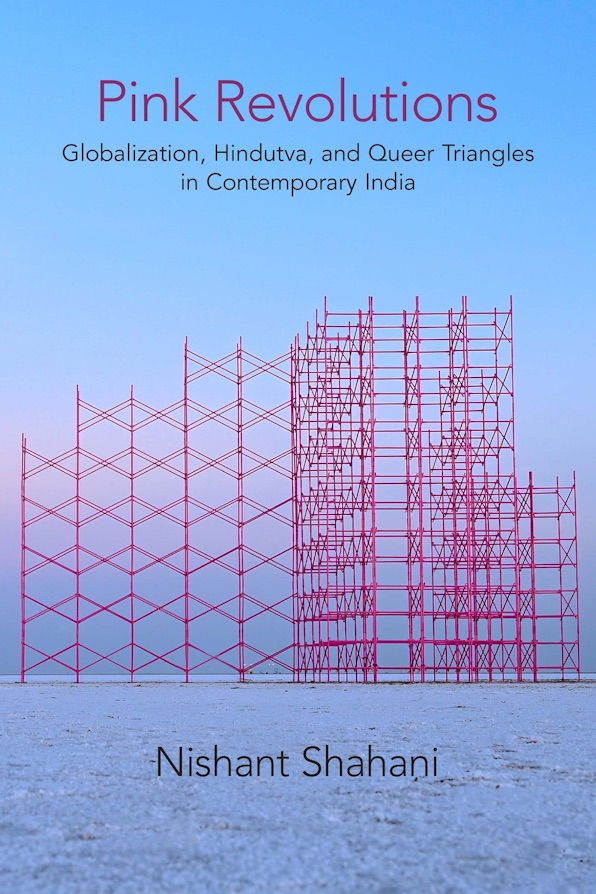
Pink Revolutions: Globalization, Hindutva and Queer Triangles in Contemporary India (Northwestern University Press, 2021)
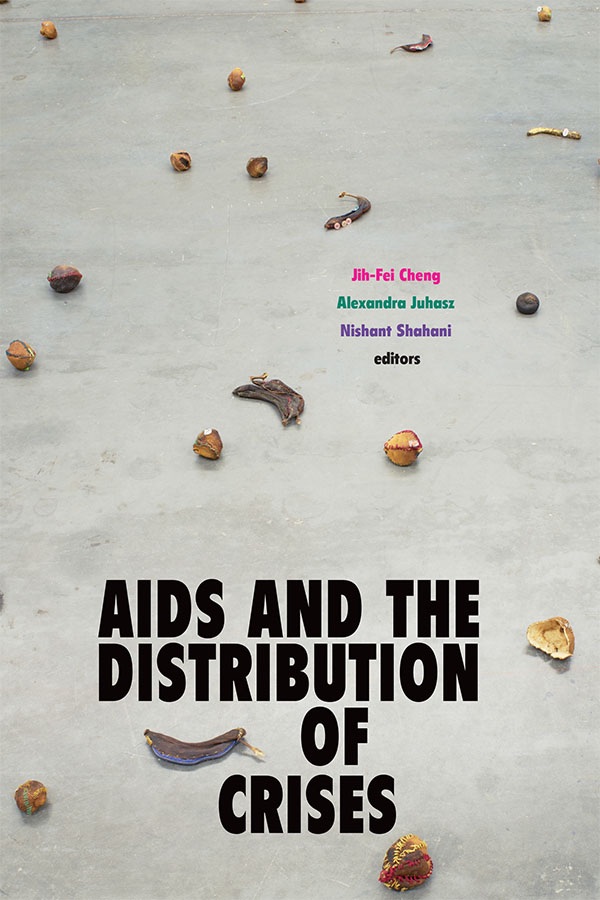
AIDS and the Distribution of Crises (Duke University Press, 2020)

Queer Retrosexualities: The Politics of Reparative Return (Lehigh University Press, 2012)
Selected Articles, Book Chapters, and Special Issue Journals
- “To Desire Differently: Contagion, Occupation, and the Threading of Crises,” (*See disclaimer) Utopian Studies, Vol. 36 (1), pp. 269–283, 2025.
- “Introduction: Autoimmunities in the Wake of COVID-19” (with Travis Alexander), (*See disclaimer) Catalyst: Feminism, Theory, Technoscience, Vol. 10 (1), 2024.
- “Global in Spirit: Deep Reading Trans-Genres,” (*See disclaimer) QED: A Journal in GLBTQ Worldmaking, Michigan State University Press, Vol. 9 (2), Summer 2023, pp. 29-50.
- “View from Above and Below: Bridging Scenes of Difference,” (*See disclaimer) Journal of Visual Culture, Vol. 12 (1), 2022, pp. 36-55.
- “Afterwor(l)ds: Beyond the Tipping Point of Queer Victory,” (*See disclaimer) Drain: A Journal of Contemporary Art and Culture, special issue, Queerfracture, Vol. 17 (2), 2021.
- “Queer Intimacy During Seditious Times: Revisiting the Case of Ramchandra Siras,” (*See disclaimer) South Asia Multidisciplinary Academic Journal: Special Issue on Gender and Sedition, edited by Svati Shah, Vol. 20, (online) 2019.
- “Patently Queer: Late Effects and the Sexual Economies of India,” (*See disclaimer) GLQ: A Journal of Lesbian and Gay Studies, Duke University Press, Vol. 23 (2), 2017, pp. 195-220.
- “How to Survive the Whitewashing of AIDS: Global Pasts, Transnational Futures,” (*See disclaimer) QED: A Journal in GLBTQ Worldmaking, Michigan State University Press, Vol. 3 (1), Spring 2016, pp. 1-33.
- “‘I Have a Voice’: Speech, Silence, and the Rehabilitation of Empire,” (*See disclaimer) Postcolonial Studies, Taylor and Francis, Vol. 18 (1), 2015, pp. 67-84.
- “Between Light and Nowhere’: The Queer Politics of Nostalgia,” (*See disclaimer) Journal of Popular Culture, Vol. 46 (6), 2014, pp. 1217-1230.
- “Getting off (on) the Shortbus: The Politics of Hypothetical Queer History,” New Cinemas: Journal of Contemporary Film, Vol. 10 (2-3), 2013, pp. 101-114.
- “‘If not this, what?” Time out of Joint and the Politics of Queer Utopia,” Extrapolation, Vol. 53 (1), University of Liverpool Press, 2012, pp. 83-108.
- “Section 377 and the “Trouble with Statism”: Legal Intervention and Queer Performativity in Contemporary India,” Genders, University of Colorado Press, Issue 50 (online), Fall 2009.
- “The Politics of Queer Time: Reparative Returns to the Primal Scene of American Studies,” (*See disclaimer) Modern Fiction Studies, Vol. 54 (4), Johns Hopkins University Press, Winter 2008, pp. 791-814.
*Disclaimer: This link leads to an external website that is not hosted by the university. The views and content expressed are those of the faculty member and do not represent the official positions of the university.