Meet the Chair
We’re in the business of building (through empathy) a better world, and making lives more meaningful and significant.
-Kirk McAuley, Chair, Department of English
The Department of English provides students with foundational writing & communication skills that are widely applicable to a rich variety of academic pursuits / careers. We offer students opportunities to meet and work with award-winning writers, gain valuable editing experience, participate in a variety of internships, and get involved in the community through various activities, including Open Mic Night at Brused Books in downtown Pullman. However, I think it must be acknowledged too that we’re in the business of building (through empathy) a better world, and making lives more meaningful and significant. That is, when asked to explain the value of an English degree to someone uncertain of what we do, I’m apt to invoke both the foundational skills we teach and Ayesha Ramachandran’s work on the Early Modern concept of the art of world making to acknowledge that we are engaged in building brighter and more sustainable futures, whether through challenging deeply ingrained biases and structures of oppression or helping us to recognize how inextricably linked we are to each other – indeed, to every living organism on this earth. In other words, I firmly believe that our work is central to the development of a just and sustainable world.
Undoubtedly, the best part of serving as the Chair of so large and complicated an organization as the Department of English at Washington State University would have to be numerous opportunities it offers to celebrate and promote the work of faculty, staff, and students – all of whom are engaged in a dazzling array of interrelated activities – readings, workshops, performances, presentations, community-engaged projects, and teaching innovations. It’s this marvelous variety that makes working in a department like ours such an experiment in forest thinking. For it’s when we take a step back and survey this vast assortment of accomplishments holistically (a perspective that one is encouraged to adopt as Chair) that we begin to see the exciting synergies (the mycelia, I like to think) that connect us together under the canopy of English studies. Indeed, it is certainly a tremendous honor and pleasure to be a part of such a vibrant, forest-like community. It’s the variety of things we do – Rhetoric and Professional Writing, Linguistics, English Education, Creative Writing, Literary Studies, Film Studies, Women’s, Gender, and Sexuality Studies – that I think some people might find difficult to fathom. But I think it’s far more exciting (and energizing) to consider the areas in which our interests as faculty and students overlap, than to focus on what distinguishes, say, one English sub-discipline from another.
Similarly, my research and teaching are situated in the broad, interdisciplinary fields of eighteenth- and nineteenth-century transoceanic studies, with emphases in literature and ecology, de-colonialism and Empire, the Gothic (or politics of horror), and gender studies. I am the author of two books, including The Ecology of British and American Empire Writing, 1704 – 1894 (Edinburgh University Press, 2024), which was supported by a 2015 – 2016 US-UK Fulbright Scholarship at the National Library of Scotland in Edinburgh, UK, and which was selected by ASLE (Association for the Study of Literature and Environment) for their 2024-2025 Spotlight series. And I served as the Lawrence Ruff Chair in Eighteenth-Century Studies at the University of Dayton in Fall 2019. I am presently working on a third book, a critical revaluation of eighteenth- and nineteenth-century Imperial Gothic Fiction and the radical ways in which Gothic natures (animals, plants, and minerals) displace the “traditional humanistic unity of the subject” (Bradiotti). In this particular respect, my new book project aims to recover through archival research the critical, ecofeminist insights of Victorian women writers residing in India, and (at the same time) to explore how indigenous communities in the Caribbean and South Asia remain haunted by efforts to appropriate so-called “cheap natures” from these regions.
I teach courses in eighteenth- and nineteenth-century literature focusing on a variety of areas: Contradiction, the Gothic, and Science Fiction Film. And, in whatever class I happen to be teaching, my primary goal is always the same: to create opportunities for students to engage in meaningful conversations about literature and culture – conversations that touch upon some of the most urgent problems confronting the world today.
Thank you.
Best wishes,
Kirk
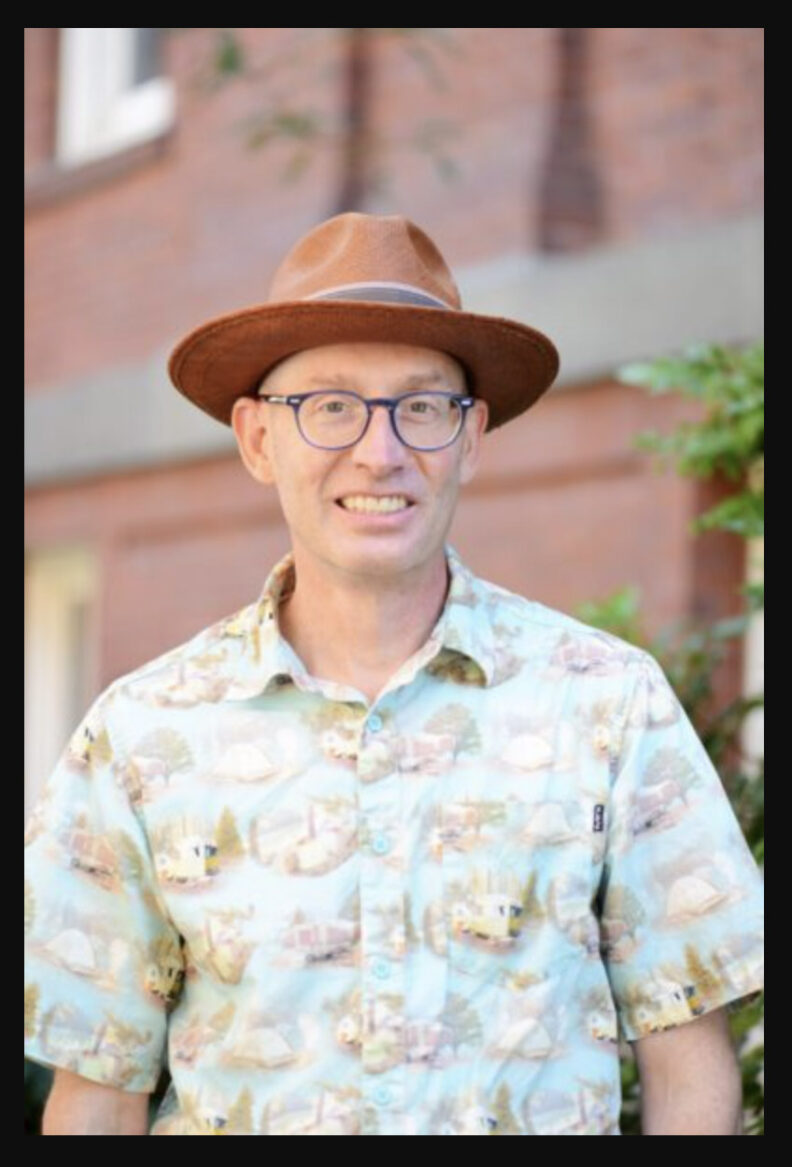
Kirk McAuley, Chair, Department of English